
March 19, 2026 • Elise Rowan
What changed on this page. The earlier version was written as if by the operator, inviting readers to celebrate with Solibet Casino the love story between art and gambling, and it printed a line about the devil dancing in the eyes of the players, labelled as inspired by Edvard Munch's own words. Munch wrote no such sentence. Every work named below can be checked in a public collection.
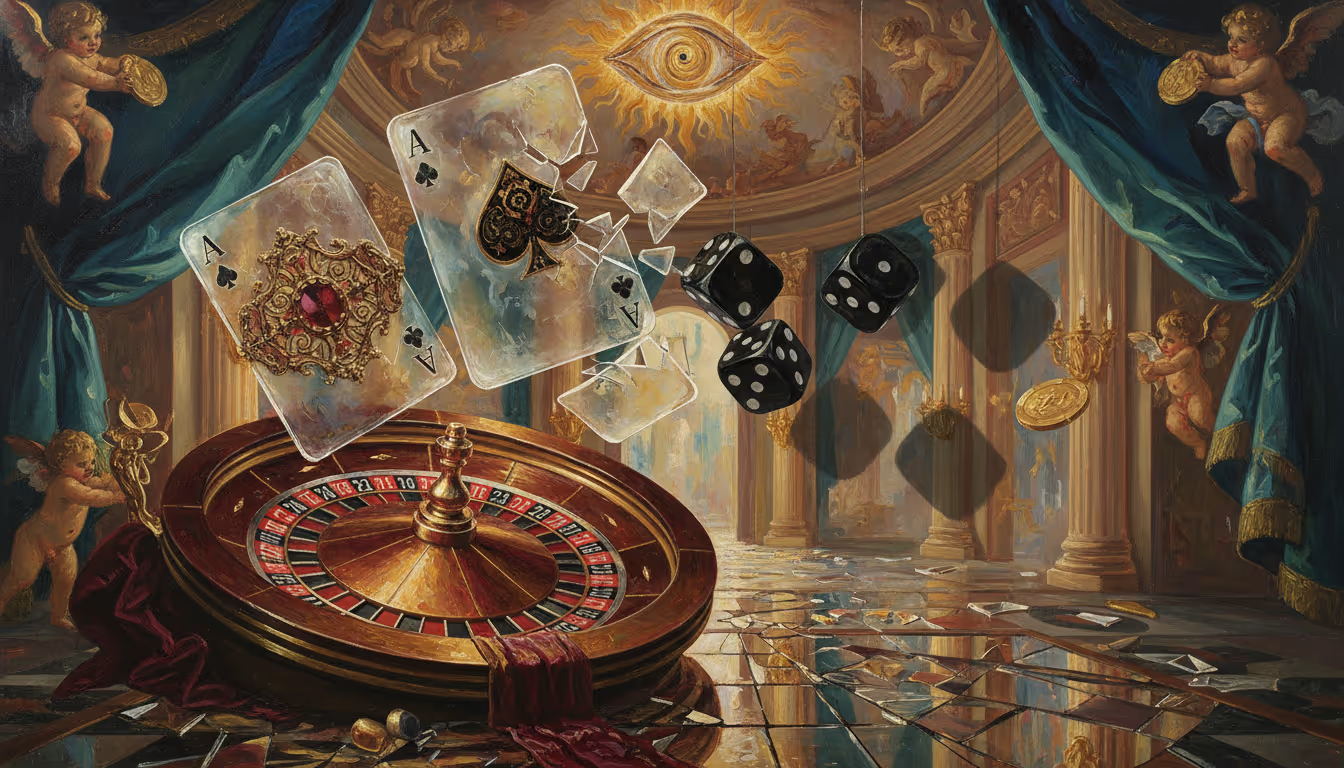
The works that exist, and where they hang
Caravaggio's The Cardsharps, painted around 1594, shows a boy being robbed at cards by a pair working together: one reads his hand over his shoulder and signals, the other has a card tucked into his belt. It is the founding image of the genre, and almost every later cheating scene borrows its staging. Georges de La Tour returned to the idea a generation later in two versions of a cheat with a hidden ace, the mark now flanked by a courtesan and a servant, everyone looking sideways at everyone else.
Paul Cezanne took the drama out: between about 1890 and 1895 he painted five canvases of card players, mostly farm workers from his own estate, with no cheat, no money in sight and nothing happening but concentration. Edvard Munch went the other way, visiting the casino at Monte Carlo in the early 1890s and painting the roulette room as a crowd of hunched backs around a green table, the light draining out of everything that is not the layout.
The most reproduced gambling pictures in the world, though, were advertising: in 1903 the printing firm Brown and Bigelow commissioned Cassius Marcellus Coolidge to produce a series for calendars and cigar promotion, sixteen paintings, nine of which put dogs around a card table.
| Work | Artist | Date | Where it is |
|---|---|---|---|
| The Cardsharps | Caravaggio | about 1594 | Kimbell Art Museum, Fort Worth |
| The Cheat with the Ace of Clubs | Georges de La Tour | about 1630s | Kimbell Art Museum, Fort Worth |
| The Cheat with the Ace of Diamonds | Georges de La Tour | about 1636 | Musee du Louvre, Paris |
| The Card Players, five versions | Paul Cezanne | 1890 to 1895 | Orsay, Metropolitan, Courtauld, Barnes, private |
| At the Roulette Table in Monte Carlo | Edvard Munch | 1892 | Munch Museum, Oslo |
| Dogs Playing Poker, series of sixteen | Cassius Marcellus Coolidge | from 1903 | Private collections |
| Fiori di Como, lobby ceiling | Dale Chihuly | 1998 | Bellagio, Las Vegas |
Modern casino art is mostly glass and sculpture. Chihuly's Fiori di Como, installed in 1998, is a ceiling of roughly two thousand hand-blown glass forms over the Bellagio lobby; the same resort opened a ticketed art gallery that year. The purpose of both: this is not an arcade.
What an art consultant for a casino actually does
Art consultants for casinos are a real profession with a fairly dull job description. They build a collection to a theme and a budget. They commission site-specific work, which means managing an artist, a fabricator, a structural engineer and an installation window between closing and opening. They handle insurance valuations, conservation and lighting levels that will not bleach a canvas in ten years. And they work the floor plan with the architects, because in a windowless building a large sculpture is also a landmark.
That is where decoration turns into wayfinding, and it is also the limit of what art does. A commissioned ceiling changes the rent a resort can charge and the photographs guests take. It does not change a paytable, a deck composition or a wheel.
How a gaming floor is built
Two schools have argued about casino floors for thirty years. Bill Friedman, in Designing Casinos to Dominate the Competition in 2000, argued for segmented, low-ceilinged spaces, short sightlines, machines immediately inside the entrance and nothing decorative competing for attention. David Kranes had argued the opposite in a 1995 paper on the casino as a playground: open vistas, natural light, landmarks, a room people want to be in. Wynn-era Las Vegas went the second way, which is why the art appeared.
The recurring details are easy to check by walking in. No clocks, usually no windows. Carpet is loud on purpose, because a high-contrast pattern hides wear and spills between deep cleans and is unpleasant to stare at, which keeps the gaze up at machine level. Overhead light is dim and the machine faces are bright. Cash access sits inside the floor rather than by the exit, and the seats are built for long sitting. The colour scheme does its own quiet work, the subject of a separate piece on the psychology of colour in casino games.
What the design does to the money
None of it changes a payout. Every element above works on a single variable: how long you stay, and therefore how much you bet. Expected loss is turnover multiplied by the house edge, and turnover is stake times speed times time.
Put numbers on it. European roulette holds 2.70% of everything staked on it, and the American wheel with its second green pocket holds 5.26%. At 40 spins an hour at 5 units a spin, that is 200 units of turnover an hour and an expected loss of about 5.40 units on the European wheel. A slot advertising 96% return to player leaves 4% to the house, and slots run fast: 600 spins an hour at 0.50 a spin is 300 units of turnover and 12 units of expected loss per hour. Stay two hours instead of one at the same stake and speed and you double both. That is the whole mechanism, and it is why the carpet is ugly.
The same arithmetic survives every change of setting. A live-dealer table dressed as a film set, dealt by a person in front of three cameras, prices its bets by the same fixed rules as the software version, as the piece on live dealer casinos sets out. Check the numbers against any operator's published game rules, and read the welcome offers on our bonuses page with the same arithmetic in hand.
How to check an art claim
Most nonsense written about casino art is fixable in two minutes. A real work has a collection page with an accession number, or an auction record with a house, a date and a lot number; a price quoted without those three is a press release. Quotations deserve the most suspicion: a line offered as inspired by an artist's own words was written for the occasion, which is what the earlier version of this page did with Munch. A real sentence has a source, a date and a translator.
The practical part: casino design is built to extend a session, so decide its length and cost before it starts. Set deposit, loss and session limits in your account, treat that amount as already spent, and never gamble with borrowed money or on credit. If play stops feeling like a choice, call your national gambling support service.
Frequently Asked Questions
Which famous paintings show gambling?
The best documented are Caravaggio, The Cardsharps, about 1594, and Georges de La Tour, The Cheat with the Ace of Clubs, both at the Kimbell Art Museum in Fort Worth; a second de La Tour cheat, with the ace of diamonds, at the Louvre; Cezanne, The Card Players, five canvases from about 1890 to 1895; and Munch, At the Roulette Table in Monte Carlo, 1892, in Oslo. Each has a collection page with an accession number.
What does an art consultant for a casino actually do?
Four things: builds a collection to a theme and a budget; commissions site-specific work such as a lobby ceiling and manages its fabrication and installation; handles insurance valuations, conservation and lighting; and works with the architects on where each piece sits in the sightlines, so it doubles as a landmark in a windowless building. None of it touches the games.
Does casino interior design change my chances of winning?
No. The house edge is fixed by the rules: 2.70% on European roulette, 5.26% on the American wheel, 100% minus the published return to player on a slot. Design works on how long you stay and how fast you bet, and expected loss is turnover multiplied by that fixed edge. Twice the time at the same stake and speed means about twice the expected loss.
The paintings are worth looking at and the rooms are worth understanding. Neither of them changes the price of a spin, and that is the one number a casino never decorates.

Elise Rowan
Elise explores casino art, sound, color psychology, and the emotional design choices that shape memorable gaming experiences.
More details